
Advisor Profiles
Launched
Q4 2025
My Role
Sr. Product Designer
Scope
Research · Systems · Delivery
Scale
3,200+ advisors · 2M+ members

The Problem
Profiles existed. They weren't working.
of profiles running on default boilerplate content
monthly visits per profile, modest but meaningful
advisors depending on this surface to grow their practice
advisors planned; growth was about to stress a broken foundation
The organization had also announced plans to grow the advisor network by nearly 600 additional advisors. If the foundation didn’t improve first, that growth would land on top of a system that was already underperforming.
Research & Evidence Architecture
Before redesigning anything, we needed to understand what was actually there.
Engineering couldn’t quickly extract CMS data on default versus customized content, since the backend fragmentation that had accumulated over years made it technically difficult. Rather than wait, I ran a directional audit of 51 active profiles to generate enough signal to move forward.

The audit answered three questions: How much content had been customized? What differentiation patterns existed? And how much drift had accumulated since the original templates launched? The patterns that emerged — roughly 60% on boilerplate, inconsistent differentiation, external linking to team sites rather than consolidated identity — closely matched the CMS data extracted later, which validated the approach and let the team move without delay.
Competitive & Adjacent Analysis
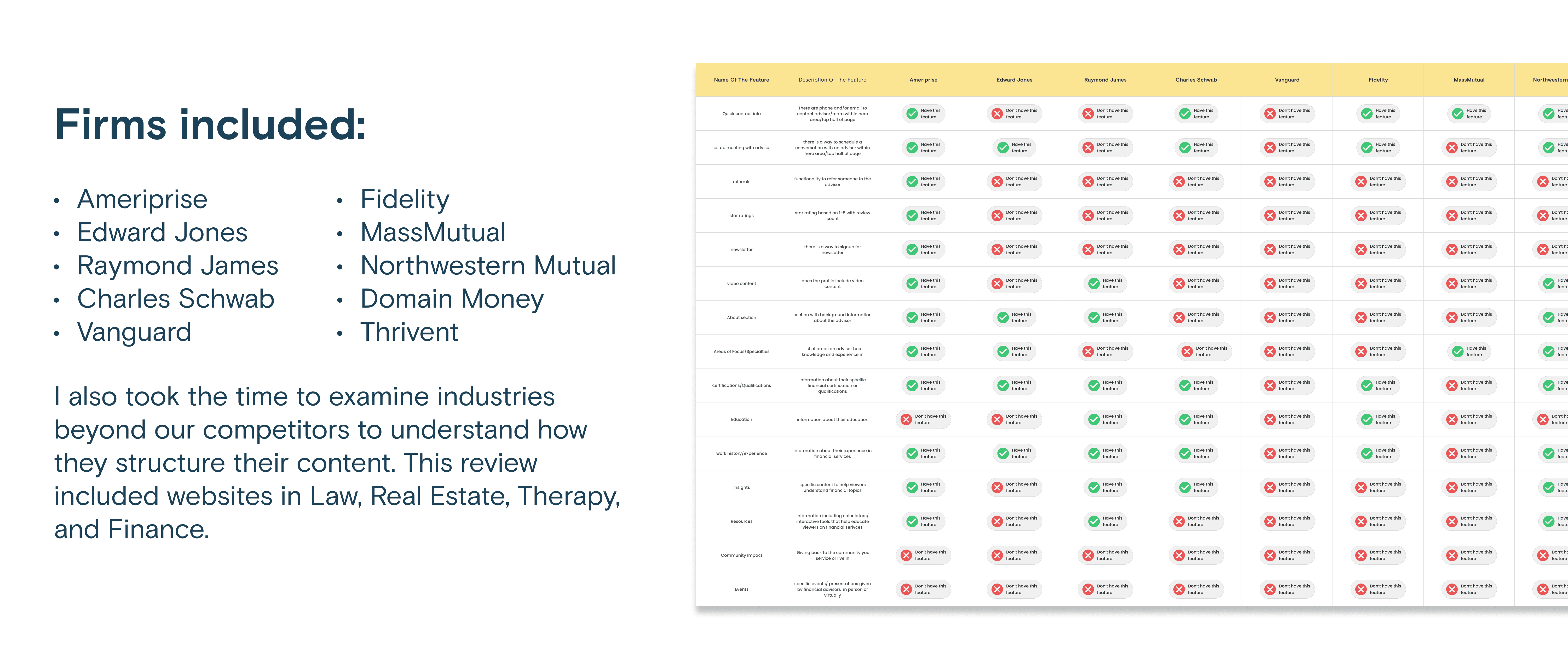
We reviewed nine peer firms and benchmarked against adjacent industries — law, real estate, and therapy — that face the same trust-building challenge in a high-stakes first-impression context. Two consistent findings cut across all of them: content volume didn’t equal credibility, and clear positioning with a direct path to connection outperformed information density every time.
Jobs to Be Done Framing
We reframed the design problem around decision progress rather than information completeness. The question shifted from “what should an advisor profile contain?” to “what does a prospect need to make a confident decision to connect?” This became the governing filter for every content and scope decision through launch, including what we explicitly chose to cut.
Advisor Interviews
Across eleven advisor and practice interviews, three themes surfaced consistently: advisors wanted to differentiate their practice, not just populate a template; they were frustrated with a backend that made updates difficult enough that most had stopped trying; and almost none were using their digital presence as an active part of how they acquired clients. Their sites were supporting tools for in-person conversations, not independent acquisition channels.
The research wasn’t just input. It became the decision architecture. Every subsequent tradeoff had a reference point.
The Inflection Point
A structural shift created the mandate, and the friction.
The inflection point came when leadership moved ownership of advisor profiles from marketing to a newly formed product-led Profiles team, and flattened the previous tiered service model. High-producing teams lost their dedicated marketing support. Product leadership was simultaneously in transition.
This wasn’t just an organizational change. It was the condition that made a real system redesign possible. For the first time, there was a mandate to build something that could scale across the entire advisor network rather than accommodate a two-tier model. My job was to translate that structural shift into a design system that could actually hold.
The System
One foundation. Controlled variation. Designed to evolve.
Every advisor needed the same strong foundation: clear hierarchy, prominent trust signals, mobile-first layout, enterprise brand alignment. Past that, differentiation had to be possible without breaking the system. That split, consistency at the core, flexibility at the edges, was the whole design decision.

Standardized Foundation
We replaced fragmented legacy structures with two templates: one for individual advisors, one for practices. This wasn’t simplification for its own sake. It was the prerequisite for everything else. Consistent structure meant consistent quality floors, measurable baselines, and a system that could actually be improved over time rather than patched advisor by advisor.
Controlled Modularity
Advisors can activate approved differentiation modules based on their positioning and practice model, while the core structure stays stable. After the MVP launch, I designed additional modules in direct response to advisor feedback gathered post-launch. Rather than shipping those modules immediately, we put them into research validation to identify which ones most effectively increased engagement before committing development resources.
Decision-Focused Content Structure
Content is sequenced around three outcomes: credibility assessment, specialization clarity, and a clear path to connection. The goal is not to answer every possible question. It’s to move the right prospects into conversation. Information that didn’t serve one of those three outcomes was cut or deferred, regardless of how long it had been on the page.
Measurement by Design
We established baseline analytics before launch so future iterations could run on performance data instead of intuition. Profiles are designed to keep improving, on connection rate, module adoption, backend update frequency, not launched once and left static.
Constraints & Decisions
The real design work was navigating what couldn’t be changed.
Several constraints shaped the system as much as the design intent did. Each required an explicit decision rather than a workaround.
Compliance
Existing approved content couldn’t be rewritten without triggering new review cycles. We reorganized and prioritized existing copy rather than replacing it, improving clarity through hierarchy, not new language.
Several planned modules were technically infeasible in the third-party platform. After attempts to close gaps with the vendor, leadership made the call to transition to an internally controlled CMS. That infrastructure work is a 2026 development priority.
In early October, leadership directed a Q4 2025 launch. Engineering’s initial assessment indicated full scope wasn’t deliverable. Rather than let the project stall, I facilitated a working session with the project owner and lead engineer to reframe the path: reduce scope to protect quality, or add engineering capacity to maintain it. We did both. We cut several modules from MVP and temporarily merged with another development pod. Individual profiles launched in November. Five practice MVPs launched in December.
High-performing teams losing dedicated marketing support were resistant to standardization. The modular system was the design response. It gave advisors a legitimate way to differentiate within a consistent structure, which addressed the real concern without compromising system integrity.
The enterprise rebrand didn’t include a defined digital execution model. Digital teams were responsible for deriving practical layout systems from brand guidance. This work was validated directly with brand stakeholders to ensure alignment before launch.
Outcome
A managed surface, not a static artifact.
Individual advisor profiles launched in November 2025. Five practice MVP sites launched in December. The Profiles team now owns this surface end to end, with a 2026 roadmap active and leadership support strong.
+1.5pp
higher prospect connection rate year over year, on average each month since launch (prospects taking action on an advisor site, divided by prospect visitors)
75%
of 500+ site visitors found the new design easy to use (intercept survey during rollout)
The meaningful shift isn’t in the visuals. It’s organizational. Profiles moved from a marketing-maintained, manually differentiated patchwork to a product-managed system with consistent quality, measurable baselines, and a defined path for improvement. Every advisor in the network now starts from the same strong foundation. Differentiation happens within the system, not around it.
Advisor engagement with profile updates has increased post-launch. Practice rollout is ongoing. The 2026 roadmap is focused on module validation, backend modernization via the new CMS platform, and expanding the measurement infrastructure established at launch.
Reflection
What this work actually required.
The design decisions in this project were rarely the hardest part. The harder work was building the conditions under which good decisions could be made and held.
+
Research as decision architecture: the audit and interviews became the team’s shared filter for every tradeoff, not just background data.
+
Constraints were the real design problem: compliance, CMS limits, and advisor skepticism each forced an explicit decision, not a workaround.
+
A timeline reframed, not a scope dropped: I turned an unrealistic executive deadline into a deliverable plan without gutting the work.
+
Built to outlast me: the system is designed for other designers to extend, not for the original designer to maintain.
This is the kind of work I find most meaningful: building systems that work under real constraints and continue improving after launch.